NIR Water-Leaving Radiance Correction
The NIR water-leaving radiance correction algorithm
(Stumpf et al. 2003) was updated to address the following:
- Correct an inconsistency with the conversion to and from Rrs and absorption/backscattering
- Implement an alternative spectral backscattering relationship
- Implement an alternative estimate for absorption in the red wavelength
- Implement a modification to the iteration scheme
Rrs to IOP
The original algorithm used an approximation of the Gordon reflectance / IOP
relationship to obtain the backscattering coefficient for the red wavelength.
It then used the full Gordon quadratic form to obtain the NIR reflectance from
the NIR IOPs. This was also inconsistent with the use of the Morel f/Q
relationship
(Morel et al. 2002) elsewhere in the atmospheric correction code. This inconsistency
was resolved by using the Morel f/Q relationship for the NIR water-leaving radiance model.
Spectral Backscattering
The original algorithm used a spectral scattering
relationship described by Gould et al. (1999) for the spectral
backscattering relationship. This fixed relationship resulted in a retrieved
NIR reflectance ratio that was significantly different from expectation
(e.g.,
Ruddick et al. 2000;
Hu et al. 2000).
The revised method implements a spectral backscattering estimate described in
Lee et al. (2002).
This relationship derives the backscatter slope as function of a reflectance ratio. The
resulting NIR reflectance ratio is more in line with the Ruddick and Hu estimates.
Estimating Absorption
The estimation of the absorption coefficient for the red wavelength previously involved
two functions, one based on chlorophyll concentration, the other on a green/red
reflectance ratio. This was modified to be a single, chlorophyll-based
relationship derived using the NOMAD dataset.
Iteration Scheme
The original iteration scheme used the average of the retrieved NIR water-leaving radiances as the term on which
convergence was tested. This has been changed to test convergence on the retrieved Rrs in the red wavelength.
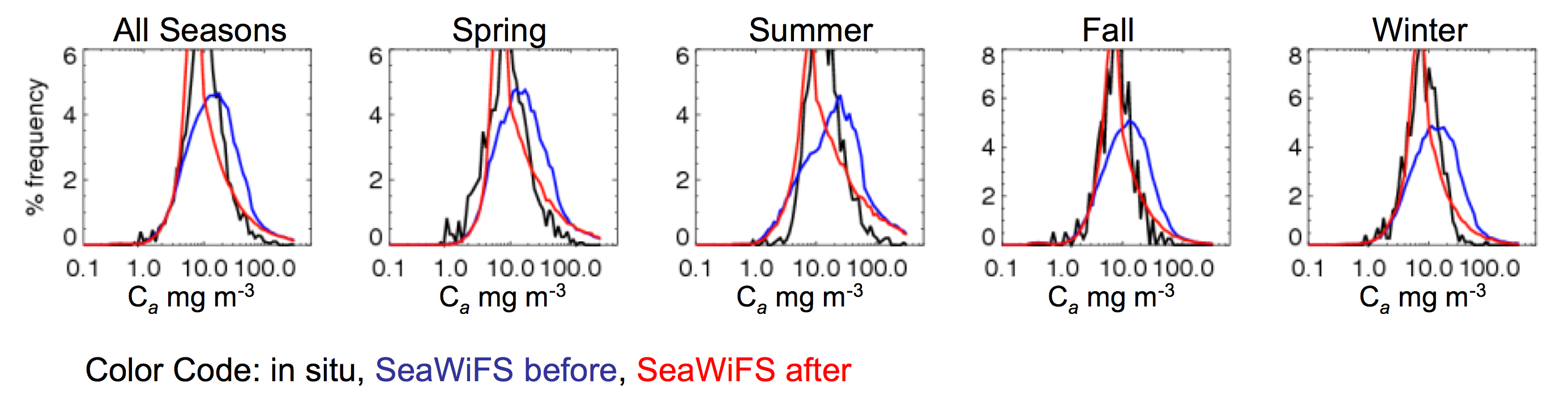
As seen in the Chesapeake Bay
regional time series analysis, the effect of these modifications is to
significantly reduce the
incidence of negative water-leaving radiance in the shorter wavelengths (412 - 490nm), and to
substantially improve agreement in chlorophyll retrievals relative to ground truth measurements in
the turbid and highly productive region of the upper bay (see Figure below).
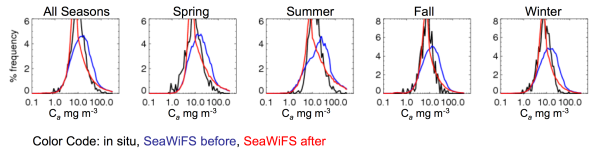 Distribution of SeaWiFS-retrieved and measured chlorophyll in the northern reaches of Chesapeapeake Bay.
Blue is SeaWiFS before the revised NIR water-leaving radiance correction, red is SeaWiFS after the revised correction,
and black is ground truth. See Werdell et al. (2009) and
Werdell et al. (2007) for information on the field data and analyses.
Distribution of SeaWiFS-retrieved and measured chlorophyll in the northern reaches of Chesapeapeake Bay.
Blue is SeaWiFS before the revised NIR water-leaving radiance correction, red is SeaWiFS after the revised correction,
and black is ground truth. See Werdell et al. (2009) and
Werdell et al. (2007) for information on the field data and analyses.
References
Stumpf, R.P., R.A. Arnone, R.W. Gould, Jr., P.M. Martinolich, V.
Ransibrahmanakul (2003). A partially-coupled ocean-atmosphere model for
retrieval of water-leaving radiance from SeaWiFS in coastal waters.
chapter 9 In: Patt, F.S., et al., 2003: Algorithm Updates for the
Fourth SeaWiFS Data Reprocessing. NASA Tech. Memo. 2003--206892, Vol.
22, S.B. Hooker and E.R. Firestone, Eds., NASA Goddard Space Flight
Center, Greenbelt, Maryland.
Morel, A., D. Antoine, and B. Gentili (2002). Bidirectional reflectance of
oceanic waters: acounting for Raman emission and varying particle
size phase function, Appl. Opt., 41:6289-6306.
Richard W. Gould Jr., Robert A. Arnone, and Paul M. Martinolich, "Spectral Dependence of the Scattering Coefficient in Case 1 and Case 2 Waters," Appl. Opt. 38, 2377-2383 (1999).
Kevin George Ruddick, Fabrice Ovidio, and Machteld Rijkeboer, "Atmospheric Correction of SeaWiFS Imagery for Turbid Coastal and Inland Waters," Appl. Opt. 39, 897-912 (2000).
Chuanmin Hu, Kendall L. Carder, and Frank E. Muller-Karger, "Atmospheric Correction of SeaWiFS Imagery
over Turbid Coastal Waters:A Practical Method", Rem. Sen. Env., 74:195-206 (2000).
ZhongPing Lee, Kendall L. Carder, and Robert A. Arnone, "Deriving Inherent Optical Properties from Water Color: a Multiband Quasi-Analytical Algorithm for Optically Deep Waters," Appl. Opt. 41, 5755-5772 (2002).